
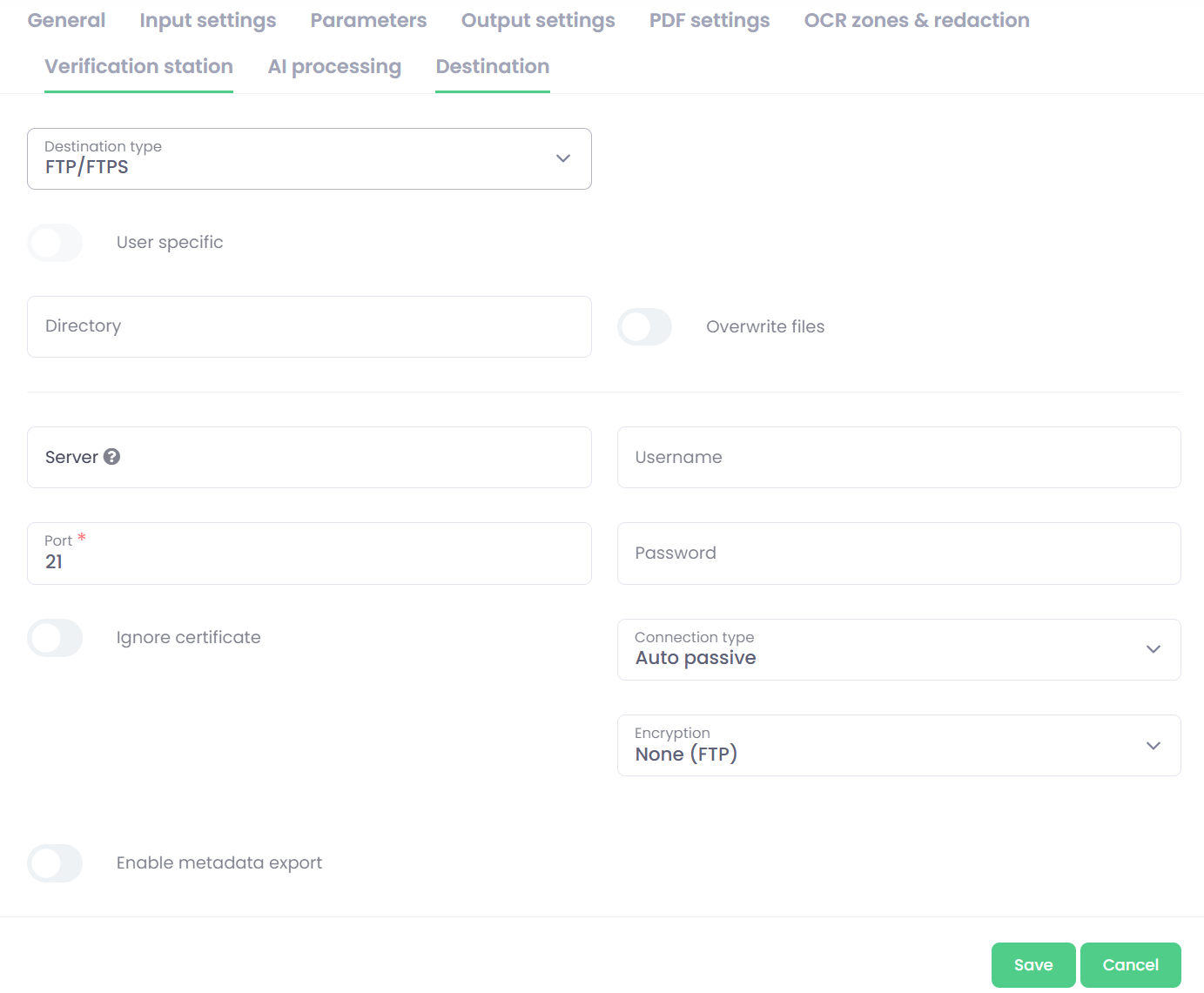
Use the FTP/FTPS destination to deliver scanned documents from OptimiDoc Cloud directly to a folder on your FTP (or FTPS) server.
FTP/FTPS destinations are non‑user‑specific only. User‑specific mode is not supported for FTP/FTPS.
-
Select the FTP/FTPS destination type.
-
Enter the configuration fields:
-
Directory - Enter the final directory for scanned documents on your FTP/FTPS server (e.g.,
/incoming/scans). You may use parameters for dynamic paths if your design requires variable directories. -
Overwrite files – Enable to replace an existing file when a document with the same name already exists. If disabled, OptimiDoc Cloud automatically appends a suffix (e.g.,
_001) to avoid overwriting.
Tip: If multiple users or devices deliver to the same path, consider keeping Overwrite files off and include parameters (e.g., date/time or device) in the file name to ensure uniqueness.
-
Server - The IP address or DNS name of your FTP/FTPS server (e.g., ftp.example.com).
-
Port - The port number used by your server (commonly 21 for FTP/Explicit SSL, 990 for Implicit SSL; confirm with your admin).
-
Username / Password - Valid FTP account credentials with permission to create files in the target directory.
-
Connection type - Choose Active or Passive depending on your network and firewall configuration. Passive mode is often simpler through firewalls/NAT devices, but follow your organisation’s policy.
-
Encryption
-
None – standard FTP without encryption (not recommended on untrusted networks).
-
Explicit SSL – negotiates TLS/SSL over the standard FTP port.
-
Implicit SSL – requires TLS/SSL from the beginning of the connection (often port 990).
-
-
Ignore certificate (FTPS only)
Set to Yes to skip certificate validity checks (e.g., for self‑signed certs). Use only if aligned with your security standards. -
Enable metadata export – activate this option to save a metadata file alongside the document.
Configuration of metadata files is described here: